







- 1
- 06.11.2026 11:20:00
- 4 min read
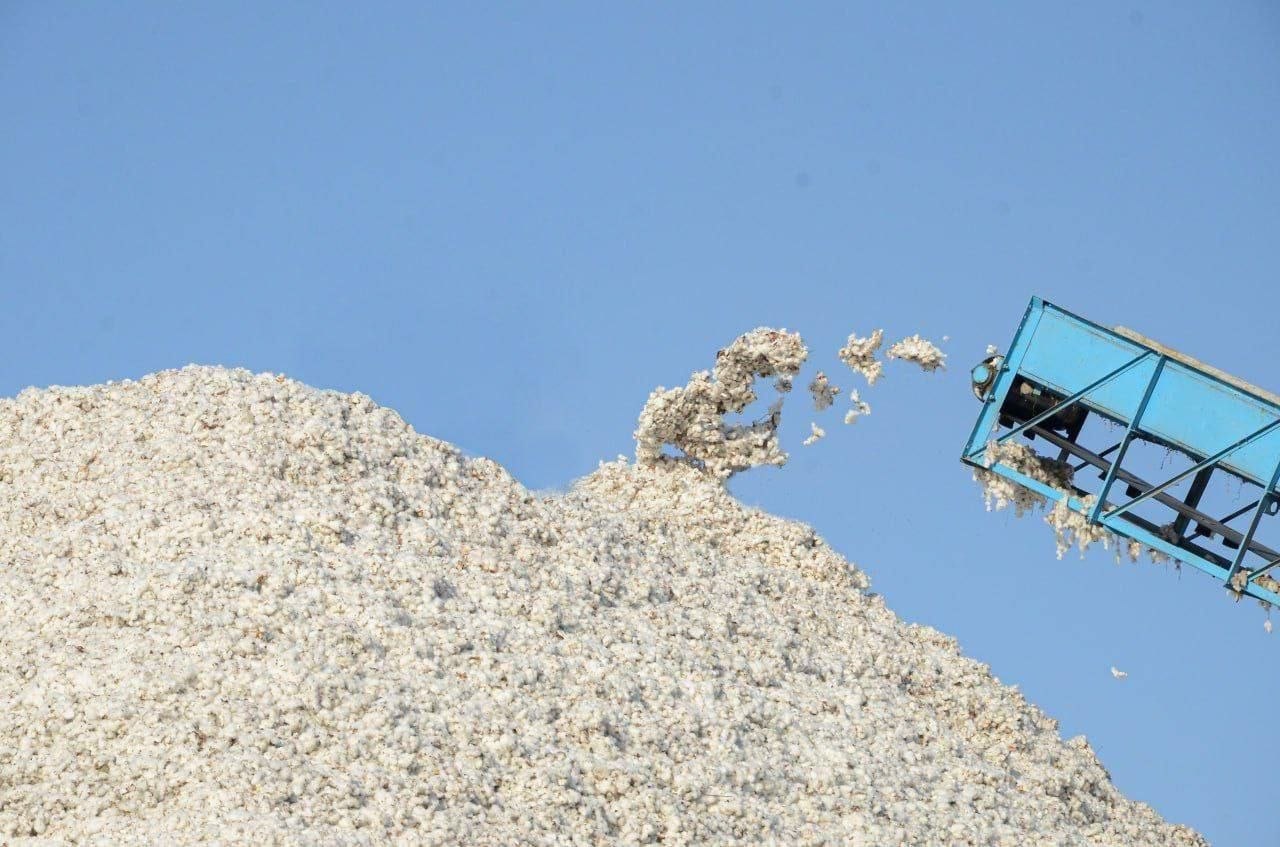
Following the 2025 harvest season, Uzbekistan collected more than 5 million tonnes of cotton — over 1 million tonnes more than in the previous year. This marks the highest cotton harvest recorded throughout the country's years of independence.
According to the Ministry of Agriculture, cotton yields reached 56.2 centners per hectare. The ministry has identified eight key factors behind this achievement.
1. Proper Planting Patterns — The Foundation of a High Yield
In cotton cultivation, planting patterns with 90 cm and 60 cm row spacing were completely phased out and replaced with paired-row planting at 76 cm spacing and single-row planting at 76 cm spacing.
Under the paired-row 76×10 cm planting pattern, plant density was increased to 220,000–240,000 plants per hectare, while the 76 cm single-row pattern provided 160,000–180,000 plants per hectare (compared with 80,000–110,000 plants previously).
The paired-row 76×10 cm pattern was implemented across 670,700 hectares (75%), while the 76 cm pattern covered 218,800 hectares (25%).
2. High-Quality Varieties — The Basis for Higher Yields
Across the country, foreign cotton varieties resistant to bollworms and herbicides were planted on 603,800 hectares (68%), while domestic early-maturing varieties with high-quality fibre were cultivated on 285,700 hectares (32%).
To expand cotton production using advanced agricultural technologies, seeds were planted using the Xinjiang method on 305,200 hectares, an increase of 124,000 hectares compared to the previous year.
3. A Science-Based Approach — Delivering Effective Results
Based on scientific recommendations, eight key principles — referred to as the eight essential "rules" of cotton cultivation — were developed for farmers and cotton clusters to follow. Cotton production was organised in accordance with these principles.
They include: optimal plant density, planting patterns, crop management, plant nutrition, accelerating cotton maturation, establishing protective zones, compliance with good agricultural practices and established requirements, and maintaining environmentally clean fields.
4. Proper Plant Nutrition — Supporting Healthy Plant Development
To improve cotton plants' resistance to drought, extreme heat and pests, treatments were applied using boric acid, aspirin, yeast and silicon-based fertilisers.
5. Agronomic Care — A Key Factor in Increasing Productivity
To ensure full cotton maturation and increase yields, a new science-based approach was introduced, involving systematic defoliation and desiccation in three stages.
-
Stage 1 — Treatment with ethephon to accelerate the opening of cotton bolls.
-
Stage 2 — Defoliation using mild-action defoliants.
-
Stage 3 — Desiccation using stronger preparations and desiccants (diquat + ion).
These measures accelerated the full opening of cotton bolls and made it possible to harvest the developed crop within a shorter period.
6. Technology and Mechanisation
Mechanised cotton harvesting was introduced on a wider scale. A total of 2,800 cotton-picking machines were deployed during the year. This enabled the crop to be harvested in a single pass and reduced the harvesting period from two months to one.
7. Passing on Experience and Expertise
To increase cotton productivity through the introduction of scientific advances, the Mentor–Apprentice initiative was launched in 2026.
A total of 4,658 farmers who had achieved an average yield of less than 30 centners per hectare in 2025 were paired with 946 experienced and dedicated farmers and representatives of cotton clusters who had achieved yields of 50–60 centners per hectare. Each mentor was assigned five apprentices.
All agronomic activities carried out under this initiative for the 2026 cotton harvest are being monitored through the Digital Agriculture platform.
A special "Mentor's Logbook" was also developed to ensure the timely and high-quality implementation of agronomic activities and to record the knowledge and practical skills transferred from mentors to apprentices.
The system enables the monitoring of the timely and proper implementation of agronomic measures in cotton fields, the assignment of additional tasks based on crop conditions, and the assessment of task completion results.
8. Financial Support and Resources
A systematic financing mechanism has been established to ensure the timely implementation of agronomic activities in cotton production.
For the 2026 cotton harvest, 12 trillion soums in preferential loans were allocated.
In addition, farmers receive a subsidy of 1 million soums for every tonne of raw cotton sold through commodity exchange trading. The total amount of subsidies reached 2.4 trillion soums, representing an increase of 0.6 trillion soums.
For comparison, subsidies amounted to 1.8 trillion soums in 2025 for the 2024 harvest, while 2.4 trillion soums were allocated in 2026 for the 2025 harvest.