



- 7
- 01.05.2023 08:36:00
- 5 min read
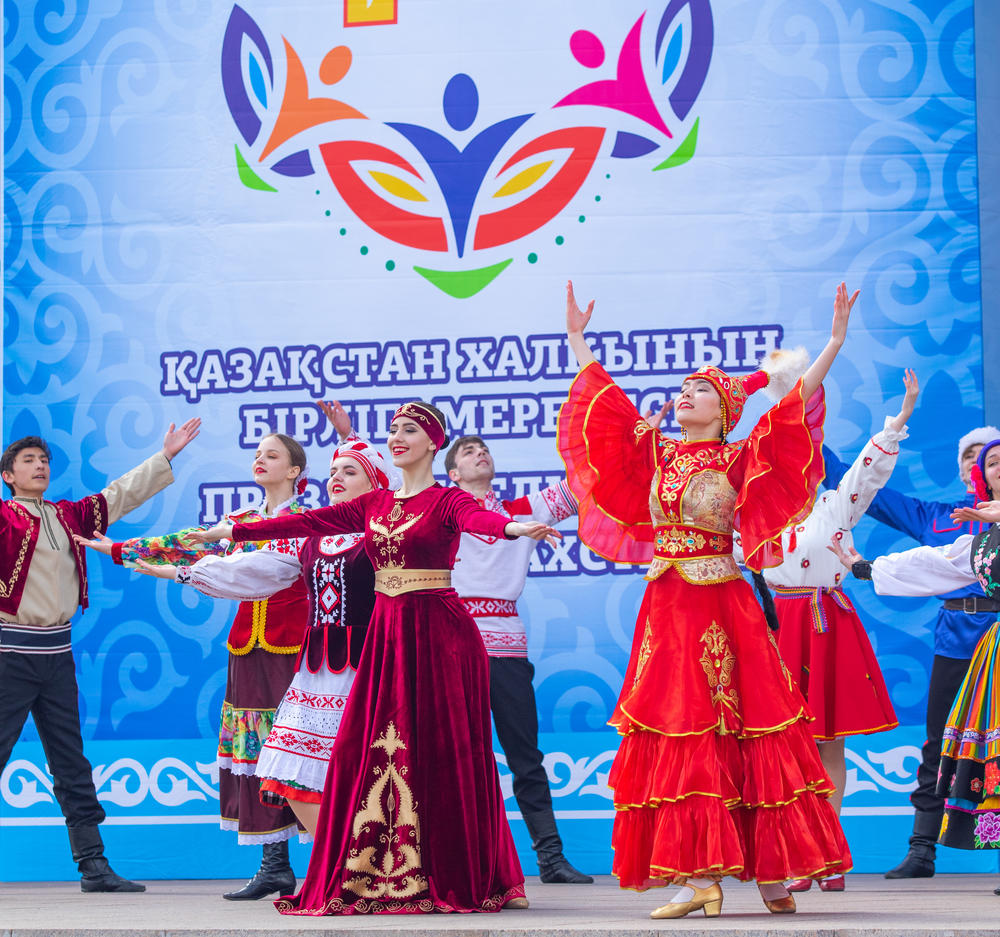
On the first of May, the Day of Unity of the People of Kazakhstan is celebrated - a holiday of friendship and harmony of all ethnic groups of Kazakhstan. According to the Assembly of People of Kazakhstan, more than 130 ethnic groups live in peace and harmony in the republic. The unity of the people is an indicator of a strong and prosperous state, which is based on tolerance and intercultural dialogue. Today the population Kazakhstan has 19,808,430 people. Of these, 70.6% are Kazakhs, the share of the Russian population is 15.1%, Uzbeks - 3.2%, Ukrainians - 1.9%, Uighurs - 1.5%, Germans - 1.1%, Tatars - 1.1%, Azerbaijanis - 0.7%, Koreans - 0.6% and other nationalities. Every year on May 1, festive festivities, concerts, sports competitions are held in the cities and villages of the republic, people go to visit and cover the dastarkhan. Over the years, the holiday has become a good tradition uniting all Kazakhstanis. The holiday of unity of the people began to be celebrated since 1996. On October 18, 1995, a decree was signed declaring May 1 the Day of Unity of the People of Kazakhstan, thereby canceling the celebration of the Day of International Workers' Solidarity. May 1 is celebrated in the countries of the former USSR, in the USA and a number of countries in Europe, Africa, Latin America and Asia. It is known by several names at once - International Workers' Solidarity Day, Spring and Labor Day, Labor Day, Spring Day. In Soviet times, this holiday by the date of its holding was the red day of the calendar and was called May 1 or May Day. The emergence of the tradition of celebrating May Day is connected with the events that took place in Chicago in the nineteenth century. On May 1, 1886, large-scale rallies and demonstrations of workers began in the city, who demanded that their employers introduce an eight-hour working day. The action ended in clashes with the police. On May 3, police opened fire on strikers at the Cyrus McCormick harvester factory, killing at least two workers. On May 4, at a protest rally in Haymarket Square, a terrorist threw a bomb at police officers, who responded by shooting at the crowd. Sixty police officers were injured, eight were killed, the exact number of workers killed was not determined. The police arrested hundreds of citizens, and seven anarchist workers were sentenced to death. In July 1889, the Paris Congress of the Second International, at the suggestion of the French delegate Raymond Lavigne, in solidarity with the Chicago workers, decided to hold annual workers' demonstrations on May 1. On May 1, 1890, the holiday was held for the first time in Austria-Hungary, Belgium, Germany, Denmark, Spain, Italy, USA, Norway, France and Sweden. In the UK, it was held on May 4. The main slogan of the demonstrations was the demand for an eight-hour working day. In 1891, by the decision of the Brussels Congress of the Second International, the sections of the International in each country were granted the right to independently set the date and form of the celebration of May 1, after which the demonstrations in the UK and some other countries were postponed to the first Sunday in May. On May 1, 1891, the social-democratic group of the revolutionary Mikhail Brusnev organized the first festive gathering of workers in St. Petersburg. The form of May Day celebration was May Day - an illegal revolutionary meeting of workers, usually held outside the city. The Kharkov May Day, held in 1900, was the first open mass demonstration of workers in Russia, during which it was decided not to go to work and arrange a street demonstration. Since that time, on May 1, demonstrations have been held in various cities of Russia. During the First World War (1914-1918), performances on the First of May became isolated. In 1917, the holiday was freely celebrated for the first time in revolutionary Russia. Workers took to the streets with Bolshevik slogans: "All power to the Soviets!", "Down with the imperialist war!". Since 1918, the holiday has become an official and non-working day. It was enshrined in the Labor Code (in the appendix to article 104) and was called the Day of the International. In honor of the holiday in 1918, the first military parade was held in Moscow on the Khodynka field. Since 1928, the Day of the International began to be celebrated during two non-working days on May 1 and 2. On May 1, 1933, the first air parade took place over Red Square in Moscow. From that moment on, air parades were held regularly until the beginning of the Great Patriotic War, as an integral part of the demonstration of Soviet military power. The parades showed the achievements of the Soviet aviation industry - the Maxim Gorky aircraft, the fastest fighter of its time, the I-16, and others. During the Great Patriotic War (1941-1945), parades and processions in honor of May 1 were not held. On May 1, 1956, for the first time, a television report was carried out about a military parade and a demonstration of workers on Red Square in Moscow. In 1970, the Foundations of the USSR Labor Legislation assigned a new name to the holiday: May 1 and 2 officially became the Days of International Workers' Solidarity. In the era of developed socialism in the USSR, May Day demonstrations changed the meaning. On May 1, the workers of the USSR "expressed their solidarity with the revolutionary struggle of the workers of capitalist countries," as well as "with the national liberation movement." Organized columns of workers, intellectuals, and students marched through the central streets of cities and towns to marches and music of a political orientation with industrial banners. In 1992, the Workers' Solidarity Day was renamed the Spring and Labor Day. The Spring and Labor Holiday is celebrated in Russia with mass demonstrations and rallies for social and labor justice, folk festivals and concerts, RIA Novosti reports.