








- 13
- 19.01.2026 12:29:00
How Did the Duck Hunt Game Actually Work?
Many people who played Duck Hunt in childhood believed they were shooting a laser at the screen. In reality, the game was based on a very simple yet clever technology for its time.
The Duck Hunt gun was not a laser
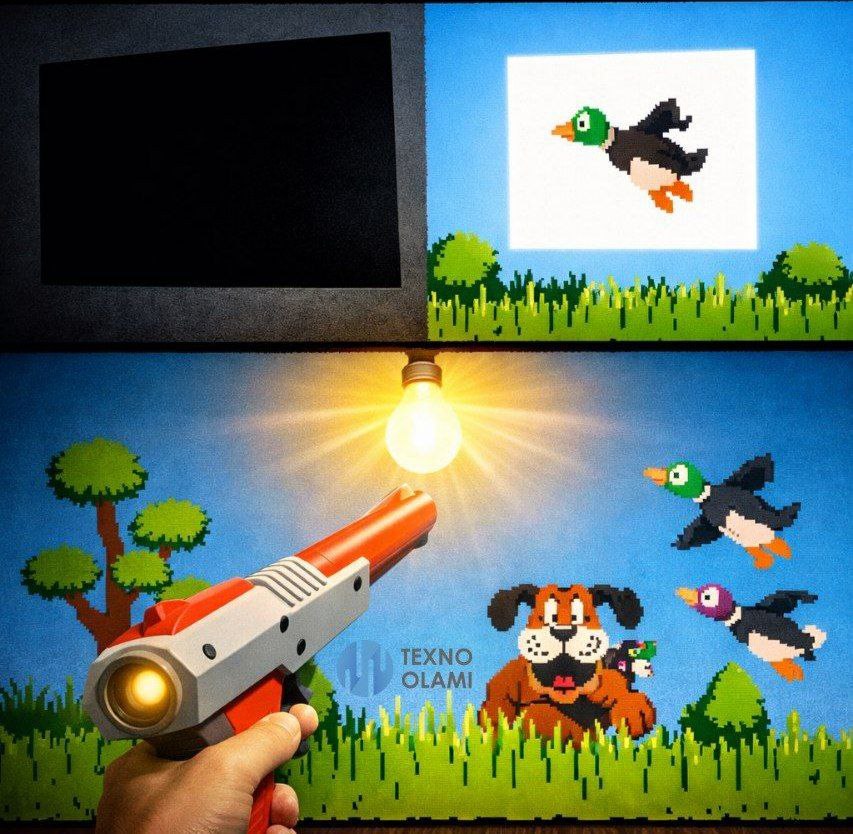
The NES Zapper gun used in Duck Hunt never fired any lasers or bullets. Instead, it contained a simple light sensor (photodiode) inside. The gun did not shoot anything — it only detected light coming from the screen.
How did the system work?
When the player pulled the trigger, a very fast sequence happened on the screen:
-
The screen turned completely black for a split second
-
The duck’s position flashed bright white
-
The gun detected whether it “saw” the bright light
If the sensor detected the white light, the system registered a hit. If not, it counted as a miss.
Why did shooting at a lamp always work?
This explains a famous trick many players discovered:
if you pointed the gun at a light bulb or a bright lamp, the game would still register a hit. The gun wasn’t detecting the duck — it was detecting brightness.
Dependence on CRT televisions
This technology only worked with old CRT (tube) televisions. Modern LCD or LED screens refresh images differently, which is why the NES Zapper does not function properly on today’s TVs.
Simple but legendary technology
By today’s standards, this technology seems extremely simple. However, in the 1980s, it was an ingenious and innovative solution. Without cameras or advanced sensors, Nintendo created an interactive shooting game using only light detection.
Conclusion
Although Duck Hunt made us believe we were firing a laser, it was actually powered by a basic light sensor. This clever simplicity is what made Duck Hunt one of the most legendary games in video game history.
Sometimes the greatest technologies are born from the simplest ideas.
